
On the morning of August 11, 2026, a car left Walnut Street in Chatham, Illinois, crossed a field, struck a light pole, and came to rest against a concrete pillar in front of the YNOT Outdoors summer camp building. Two people in their late seventies were trapped inside the vehicle. Preliminary reports suggest the driver suffered a medical episode.
No one was seriously hurt. No child was touched. The building lost an awning support beam.
If that location sounds familiar, it should. In April 2025, a driver left the same roadway and went through the same building — the YNOT After School Camp — killing five children and injuring six more. A wrongful death lawsuit filed this spring alleges, among other things, that the facility lacked adequate external barriers to stop a vehicle.
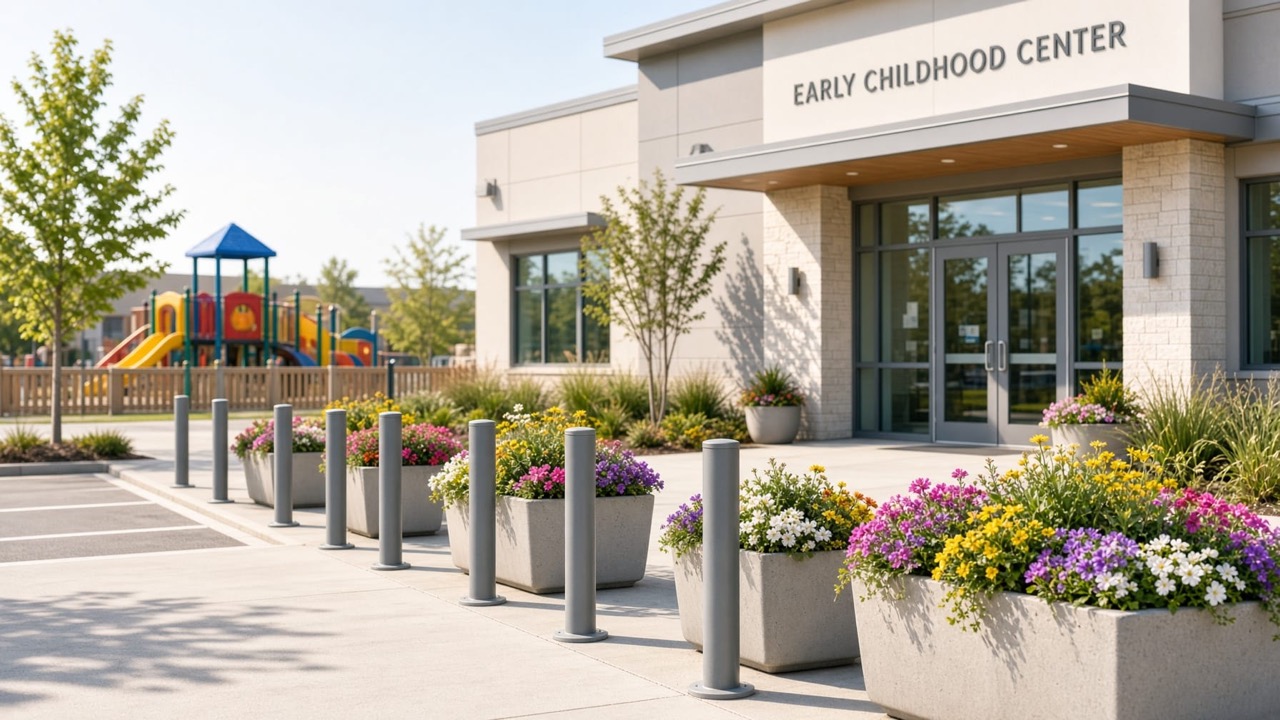
Between the two crashes, a concrete pillar was installed.
“We are thankful that that concrete pillar stopped the vehicle where it was at and that it did not get into the building where the children were,” Adam Hahn, lead investigator with the Chatham Police Department, told local reporters.
That is the entire case for vehicle-into-building protection, told in one town, at one address, fourteen months apart.
This is more common than most program leaders realize
Vehicles crash into U.S. buildings more than 100 times a day. Early childhood programs, preschools, and playgrounds are regularly among them — our analysis with the Storefront Safety Council of more than 300 incidents at early childhood sites found that roughly half resulted in injuries. Most programs sit close to the road by design: drop-off and pick-up put classrooms and play spaces, on average, just 25 feet from parking lots and drive lanes.
None of this requires a reckless driver. The Chatham crashes involved a seizure and a medical episode. Pedal error, confusion, and simple loss of control account for a large share of these incidents — which is exactly why the protection has to be physical, not behavioral.
What we’re doing about it
The Institute for Childhood Preparedness has joined the Storefront Safety Council as a partner, supporter, and founding member. The Council has spent years documenting vehicle-into-building crashes and advocating for the simple, proven measures that stop them — bollards, wheel stops, raised planters, and smarter site layout.
Together, we’ve built a resource hub for early childhood programs that includes a three-part video and podcast series with the Council’s co-founder, Rob Reiter, along with downloadable handouts for each episode. The series walks through understanding the risk, assessing your own site, and putting affordable protections in place. Many of the most effective measures cost far less than programs expect.
We are also offering 100 free Storefront Safety Risk Assessments for early childhood programs of all types. If you have ever looked at your drop-off line and wondered what stands between a moving car and your classroom windows, this is the way to find out — at no cost.
Request your free risk assessment here.
The legal dimension leaders shouldn’t skip
The Chatham lawsuit names both the program and the village, and its allegations center on questions every program owner and director should be able to answer: Where is the facility sited relative to the roadway? What barriers exist between traffic and children? Who assessed the risk, and when, and where is that documented?
Courts ask these questions in terms of duty of care. A documented site assessment — even one that identifies work still to be done — is evidence that a program took its duty seriously. Nothing on file is evidence of the opposite.
Our Legal Preparedness for Early Childhood Leaders training is built for exactly this: helping owners, directors, and leadership teams understand duty of care, documentation, supervision, and the most common areas of legal exposure — in plain language, without the scare tactics. Paired with a site assessment, it turns “we hope nothing happens” into “we can show what we did.”
Start with the assessment
The families in Chatham should never have had to learn this lesson twice. The second crash ended with a bent awning beam instead of a funeral because something solid stood between the vehicle and the children.
Find out what stands between the road and yours. Explore the resource hub, listen to the series with Rob Reiter, and request one of the 100 free assessments.