
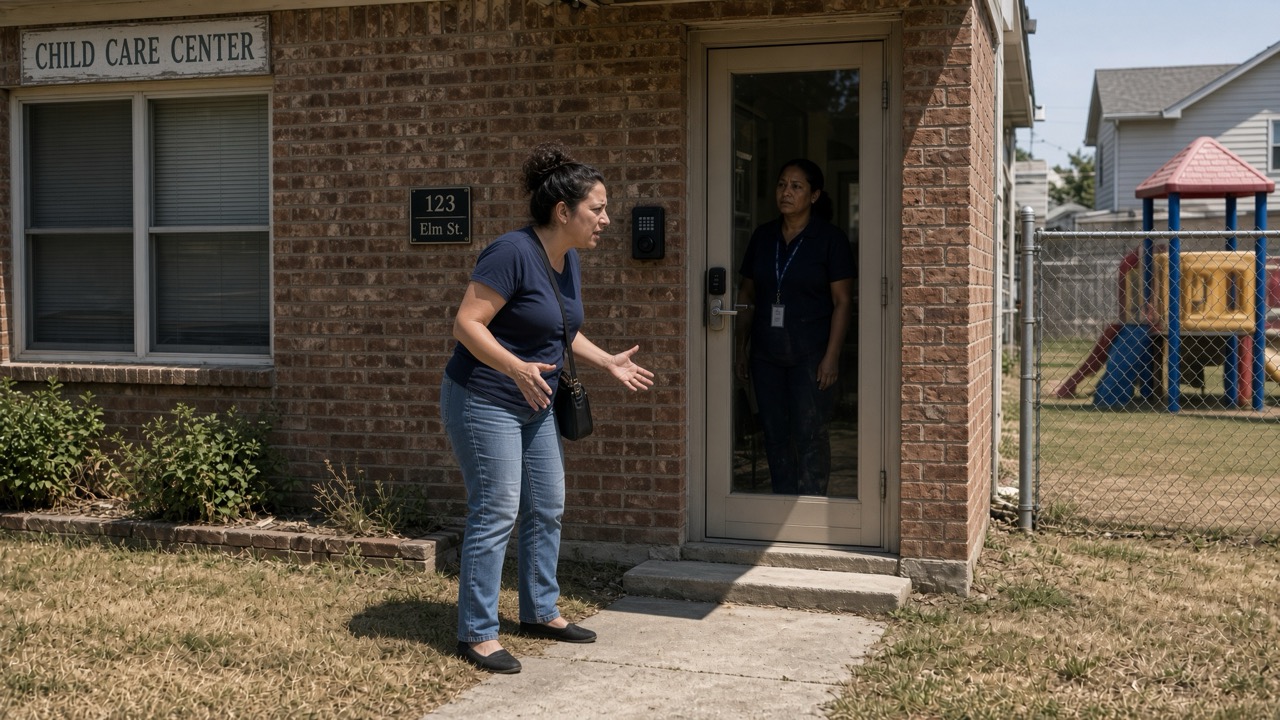
For three days in the middle of August, the owner of a Kentucky day care and academy received text messages on her phone.
They came from several different numbers. They said someone would shoot up the school. They said no one was safe.
One of them read, in part: “I will be here all day I see yall blocking off everything NO ONE IS SAFE. Better get all the kids out of the building now it’s not over I didn’t get in trouble yesterday so with that being said.”
On the third day, the program went into lockdown. The sheriff’s office was already investigating. Children stayed inside.
Then investigators traced one of the messages to a cellphone inside the building.
A 27-year-old teacher at the program has been charged with felony second-degree terroristic threatening and making a false report that generates an emergency response. According to her arrest citation, she did not want to be outside in the heat with the children, and she knew the messages would trigger a lockdown that would keep everyone indoors. Police say she confessed during questioning. She waived her preliminary hearing, and the case is now headed to a grand jury.
The charges are allegations. The preparedness lesson is not.
The Threat Was Not Aimed at the Door. It Was Aimed at the Plan.
When early childhood programs talk about insider threats, the conversation almost always turns to access. Keys. Door codes. Badges. Who can get in after hours.
That conversation matters. But it is not what happened here.
This employee was not trying to get inside. She was already inside, on the clock, in the building. She did not defeat a lock, borrow a badge, or talk her way past a staff member at the entrance.
She used the emergency plan.
Consider what the alleged plan required its author to know. That a threat of this specific kind produces a lockdown rather than an evacuation. That the program would treat an anonymous message as credible enough to act on. That the response would hold children inside the building instead of moving them out of it. Roughly how long it would last, and that it would cover the hottest part of the afternoon.
That is not knowledge of a building. That is knowledge of a procedure.
Every program that trains its staff well — and programs should train their staff well — also teaches every one of those staff members exactly which inputs produce which response. That is the entire point of training. It is also, on rare occasions, a lever.
This is not an argument for training people less. It is an argument for recognizing that your emergency procedures are a system, and that people who work inside a system understand how to move it.
There is a design answer to that, and it is not secrecy. Separate the trigger from the control: anyone may start a protective action, but one named person decides how long it lasts and when it ends. A plan built that way responds the same regardless of who set it in motion — which is what you want anyway, on the ordinary days when the person who pulled the alarm was simply mistaken.
Anonymous Does Not Mean External
Here is the assumption worth examining most closely.
A threatening message arrives from a number nobody recognizes. What is the first thing almost everyone pictures?
A stranger. Someone outside. Someone out there.
In this case, at least one message came from a phone in the academy.
Notice that the threat did not need to be sophisticated to work. It did not come from a hidden account or a foreign number. It came from a phone, from inside, and it produced exactly the outcome the sender allegedly wanted, on the first try.
Be careful what you do with that, though, because it is easy to take the wrong lesson.
The lesson is not that you should start looking sideways at your staff. It is much narrower than that, and it costs you nothing: do not hand law enforcement a conclusion.
“We do not recognize this number” is a fact. “This came from outside our program” is a guess. Report the first. Skip the second. Determining who sent a message is police work, and they are very good at it — in this case they traced it.
Your response to a threat does not change based on who you think sent it. Secure children. Call. Preserve what you have. That sequence is identical whether the sender is a stranger, a parent, or someone on your payroll — which is exactly why you do not need to figure out which one it is before you act.
The Most Common Wrong Turn
In the tabletop exercises we conduct with early childhood programs, the recurring mistake is not panic. It is not freezing, either.
It is a director moving into investigative mode.
The scenario starts, a threat lands, and the room begins working the problem: Who would say this? Was anyone written up recently? Is that the number that called about billing last month? Does this seem credible? Should we check the cameras before we call?
Every one of those is a reasonable question. Not one of them is your question.
Law enforcement investigates threats. That is their profession, they have tools you do not have, and they are measurably better at it. An early childhood employee has a different job, and it is not a lesser one: protect the children in the room, get professionals moving, and preserve what you were sent.
Investigating costs you the only resource you actually control, which is time.
So the whole thing fits in three words, in this order:
Secure. Call. Preserve.
Notice what is not in there. Assess. Verify. Determine who. Decide whether it is credible.
Credibility is not your determination to make. A threat to shoot up a building full of children gets a call, every time, including the time you are fairly sure you know who sent it and why.
The Sentence Everyone Should Have Noticed
One phrase in those messages does more work than the threats themselves:
“it’s not over I didn’t get in trouble yesterday.”
That is an escalation tell, in writing, in the sender’s own words.
Threats that draw no consequence often do not stop. They repeat, and they grow. The absence of a result the first time becomes the reason for a second time. This is one of the most consistent patterns in threat assessment, and here it is stated outright by the sender.
Three days of messages is three separate opportunities to document, preserve, and report — not one event that happened to last a while.
Your program needs a process that treats the second threat as more serious than the first, not as more familiar than the first. Staff should know precisely who to notify. Leadership should preserve the actual messages, not summaries of them. And law enforcement gets called — on the first one, not the third. A threat to shoot up a building where children are present is never the borderline case.
Early childhood professionals do not need to become threat-assessment experts. They need a phone number and permission to use it.
Why Did She Not Just Say It Was Too Hot?
This is the question worth putting on your next leadership agenda.
Strip away the criminal conduct, and there is a staffing problem underneath it. According to investigators, a teacher believed that manufacturing a shooting threat was a more available option than saying: it is dangerous outside today, and I am not taking these children into it.
Nothing excuses what she is accused of doing. But something produced the conditions in which that felt like the path.
So ask your own program directly:
Does your staff have a clear, written, approved way to say no to outdoor time in extreme heat?
Not a vague sense that a director would probably be reasonable about it. An actual policy. A temperature and heat-index threshold. Named indoor alternatives that do not require anyone’s permission in the moment. A person who makes the call and communicates it to every classroom, so that no individual teacher has to negotiate it alone at 1:00 in the afternoon with eight toddlers and a schedule to keep.
When the honest path is unclear, people find other paths. Most of them are not criminal. Some of them are just quiet noncompliance, or resentment, or a teacher who takes children out in dangerous conditions because she does not think she is allowed to refuse.
Extreme heat is a hazard. Unclear authority during extreme heat is a second hazard sitting right on top of it.
Emergencies Do Not Stay in One Category
We spend a lot of time on heat as a health issue, and we should — hydration, shade, air conditioning, hot vehicles, heat-related illness in children whose bodies regulate temperature differently than ours do.
On the Childhood Chats podcast this July, we talked through exactly that with Dr. Tess Wiskel, an emergency medicine physician and climate health researcher at Harvard Medical School: why young children are uniquely vulnerable, how rising heat changes classrooms and outdoor play, and what frontline research says about where programs are least prepared. It is called The Preparedness Gap Nobody’s Talking About: Extreme Weather and Kids, and it holds up well against this story.
Because look at what a heatwave did here.
It changed the daily schedule. It put pressure on staff. It created a conflict about outdoor time. And it ended in a felony charge, a lockdown, deputies on site, and a program’s families reading their center’s name in the news.
That is a weather emergency that became a staffing problem, then a security problem, then a reputational one.
Preparedness means asking what the second and third effects of a hazard will be, not just the first.
If extreme heat is on your mind this month — and it should be — a few things we make available at no cost:
- Protecting Children: Preventing Deaths from Hot Cars — a free 45-minute course with Amber Rollins of KidsAndCars.org, covering the risk factors behind forgotten-child incidents, the policies that prevent them, and what to do if you find an unattended child in a vehicle.
- Heatstroke Awareness Flyer — a printable you can post in a staff room or send home to families today.
- Our Spring and Summer printables — warm-weather preparedness, evacuation planning, and family-facing handouts, all free to download.
Your Written Plan Has to Cover People, Not Just Weather
Kentucky’s child-care center regulation is a useful reminder for programs in every state. Among the records a licensed center must maintain, 922 KAR 2:090 Section 9(1)(j) requires:
“A written plan and diagram outlining the course of action in the event of a natural or manmade disaster, including drills posted in a prominent place and provided to all staff, volunteers, and visitors.”
Manmade is doing real work in that sentence.
Fire drills and tornado procedures are the easy part. They are also not what most programs are missing. Your written plan should also address:
- A threat communicated by phone, text, email, or social media
- A threat that originates from someone inside your program
- A current or former employee in conflict with leadership
- An escalating parent or guardian
- A custody-related confrontation
- A person who refuses to leave
- An armed intruder
The purpose of writing these down is not to frighten your staff. It is to make sure nobody has to invent a response while an emergency is unfolding.
Five Questions for Your Leadership Team This Week — and What Good Answers Sound Like
Questions without answers are a quiz. You did not hire us for a quiz. So here is what a solid answer sounds like for each one, and where relevant, the answer we hear most often that signals a gap.
1. If an anonymous threat arrived today, who verifies it, who decides to lock down, and who is authorized to call law enforcement?
A good answer: three names, written down, each with a named backup. Anyone on staff can initiate a protective action — nobody waits for permission to secure children. One named person owns sustaining or lifting it. And calling 911 requires no one’s approval, ever, from anyone.
The answer that signals a gap: “the director, probably.” That is a habit, not a plan, and habits do not work on the director’s day off.
2. Do we preserve threatening messages themselves — screenshots, numbers, timestamps — or do we just describe them to each other?
A good answer: screenshot it with the sending number and the timestamp visible. Do not reply. Do not delete. Do not forward it into a staff group chat. Write down when it arrived and who saw it, and hand all of it to the responding officers.
This is the one place where doing something before police arrive is unambiguously your job. Preserving evidence is not investigating. A summary written from memory three days later is not evidence.
3. Does a second threat in our program get treated as more serious than the first, or as more familiar?
A good answer: the first one already got a call — that part is not conditional. The written trigger is what stacks on top: any second threat inside thirty days automatically gets an after-action review and a conversation with the responding agency, whatever came of the first. Nobody has to exercise judgment in a bad moment.
The answer that signals a gap: “we would use our judgment.” Judgment is what erodes under repetition. That is the entire mechanism by which the second threat gets treated as background noise.
4. Can our teachers point to a written policy that lets them keep children indoors in dangerous heat, without negotiating it in the moment?
A good answer: a number, an alternative, and a name. A heat threshold your program has adopted in writing, anchored to your state licensing requirements and local health department guidance. Named indoor alternatives nobody needs permission to use. And one person who makes the call program-wide by a set time each morning, so no teacher is negotiating it alone at one in the afternoon with eight toddlers and a schedule to keep.
5. When did we last practice this — and who wasn’t in the room?
A good answer: a date, and an honest list. Most plans are not weak because they are badly written. They are weak because the people who were absent that day never practiced them — substitutes, floaters, kitchen and bus staff, the teacher who started three weeks ago. Naming who missed it is the fastest improvement available to any program, and it costs nothing.
The answer that signals a gap: “it’s in the binder.” Plans in binders do not run. People do.
Practice is also what turns every answer above from a policy into a reflex. A program that has walked through a threat scenario once — badly, awkwardly, in a staff meeting with cold coffee — is dramatically better positioned than a program with a more carefully worded plan and no rehearsal.
If any answer here is unclear, that is not cause for alarm. It is a short agenda item and a good week to handle it.
Those five questions are on a one-page PDF — print it, put it in front of your leadership team, and work down the list. Free, no sign-up, no email required.
And if it would be useful to a director you know, send it along. It is a better staff-meeting opener than anything we could write for one.
Preparedness for Programs Where Children Cannot Evacuate Themselves
Active threat preparedness in an early childhood setting is not the same work it is in an office, a warehouse, or a high school.
Infants cannot evacuate themselves. Toddlers may not follow instructions. Classrooms contain cribs, and children with mobility and developmental needs, and adults who have to make decisions while physically carrying the people they are protecting.
That is why the Institute for Childhood Preparedness built Active Threat Preparedness for Early Childhood Programs specifically for this setting — recognizing options, making decisions, communicating clearly, and protecting children when seconds matter. Two others speak directly to this story: De-Escalation Techniques for Early Childhood Professionals, for the staff-conflict side, and Emergency Preparedness for Early Childhood Programs, where the written-plan work actually gets done.
The goal is not to expect the worst every day.
The goal is to know what to do on the day something unexpected happens.
Don’t be scared. Be prepared.
The circumstances described here come from reporting by the Bowling Green Daily News. The individual charged has not been convicted, and all allegations described are allegations. We have chosen not to name her or the program.